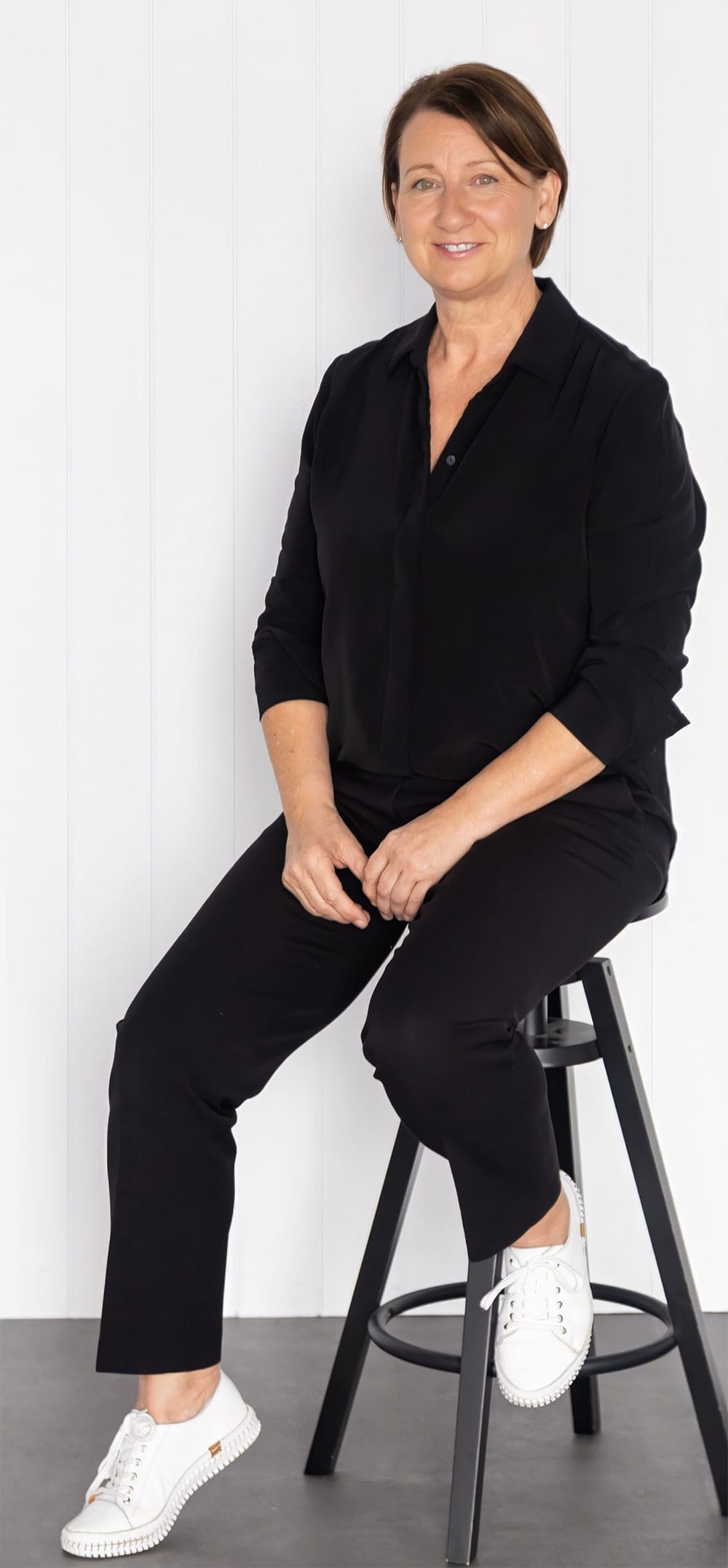
I’m Julie Hammond – Director of Anatomy Trains Australia and New Zealand, Structural Integration practitioner, educator, and author working in the bodywork industry for 26 years. I’m also a mum and a loving granny to three beautiful grandchildren.
I began my career in the UK as a sports and remedial massage therapist, guided by an exceptional tutor and mentor, Gareth Davies. Gareth gave me confidence, curiosity, and a deep respect for learning – qualities that still shape my work today.
A career turning point came when I met Tom Myers in Dublin and that single meeting was life-changing.
For the first time, fascia, whole-body connection, and anatomy made sense in a way that matched what I felt under my hands. Structural Integration gave language and structure to my touch.
I trained in Structural Integration with Tom Myers and eventually moved to Australia, becoming the first Anatomy Trains Structural Integration practitioner in the country. While exciting, it was also isolating, which led to the founding of my training company – not just to teach techniques, but to connect like-minded therapists who wanted to think differently about the body.
Even now, with a full teaching schedule, I continue to run a clinical practice. This is a non-negotiable for me because I feel this is key to teaching. My clinical work informs my teaching, and my teaching continually re-shapes my practice.
In recent years, I’ve ticked off some big goals: writing my book The Pelvic Diaphragm, completing a university degree in Human and Medical Science, and unexpectedly falling in love with AFL. Working with professional AFL players has allowed me to see just how powerful structural integration and fascial thinking can be in high-performance sport and rehabilitation.
Today, I teach the full Anatomy Trains Structural Integration program, sit on the Anatomy Trains education committee, and co-developed Balancing the Diaphragms with Fiona Palmer – a workshop series exploring the functional and fascial relationships between the body’s diaphragms.
What drives all of this is simple: I love seeing change. I still get excited when a client moves differently, breathes more freely, or understands their body in a new way.
My passion is pelvic health and translating complex anatomy into something practical, relevant, and usable in the treatment room.
If you read my book or choose to study with me, you’re not just learning anatomy – you’re learning from someone who continues to question, test, apply, and refine. Someone who believes that understanding the body should feel inspiring, not overwhelming.